The medical home is a way of working.
A familiar team, a clear next step, and care that connects. What the patient-centred medical home means beyond the name.
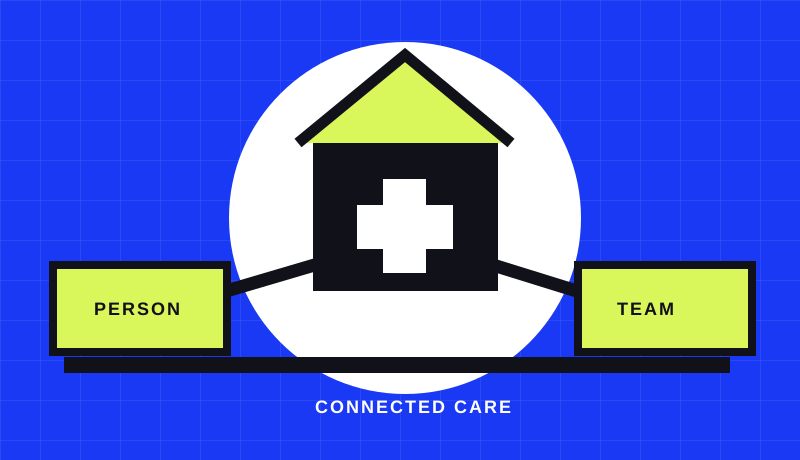
Start with the model, not the building
A medical home is an approach to organising primary care. It does not mean that every appointment takes place in someone's home, or that one building provides every service. The idea is that a person's regular care team helps connect the parts of their care.
The US Agency for Healthcare Research and Quality describes five attributes: comprehensive care, patient-centred care, coordination, accessibility, and quality and safety. Those words describe an ambition. The useful question for a practice is how each one shows up in an ordinary week.
Imagine a patient asking about a referral, a follow-up appointment and an unanswered message. A polished website cannot tell us whether those three requests will reach the right people. To understand the service, follow the work from first contact to the next agreed step.
Read the model from the patient's side
Our editorial starting point is to replace an abstract promise with a question someone can actually ask. Who is my regular contact? How do I get help when that person is away? What happens after I see a specialist? Where will the agreed plan be recorded?
A practice may have good answers without using the term medical home. Another may use the term while still leaving people to join up the information themselves. The label and the experience need to be examined separately.
A useful test
Choose one routine journey through the practice. Identify the next step, the person responsible for it, and how the patient will know it has happened. This is a discussion exercise, not a clinical standard or certification test.
The work extends beyond a consultation
A consultation is visible. Scheduling, interpreting messages, requesting missing records, organising follow-up and explaining the plan are less visible. A model of coordinated care has to account for both.
For a team discussion, sketch a simple sequence: contact, appointment, decision, next action, follow-up. Then add the people who take part. Mark the places where work changes hands. Does each handover have an owner, or does everyone assume someone else is doing it?
This sketch is deliberately modest. It is an original way to structure a conversation, rather than a claim that five boxes describe every patient journey. Complex care, urgent situations and different health systems need their own arrangements.
Keep the local context in view
The medical home has a particular history in US primary care. Payment, recognition programmes, professional roles and access routes vary between countries. A US recognition scheme should not be presented as a requirement for a practice elsewhere.
WHO's work on primary care provides a broader lens: care organised around people, continuity over time, and connections between services. The shared idea is useful; the operating details still need local evidence.
When comparing two models, write down the population, the care setting and the actual service change. Ask what was measured, over what period, and with what comparison. A reassuring name is not evidence of lower costs or better outcomes.
One place to begin
Start with a handover that the team finds frustrating. Map what happens today before choosing software or rewriting the whole service. Invite the people who receive the work as well as those who send it. Check the patient's experience, too.
The purpose is to make a shared problem specific enough to discuss. From there, a team can choose an appropriate improvement method and evaluate a change. Our referral guide follows one such handover; the team-based care explainer looks at who takes responsibility.
Sources & further reading
- AHRQ · Defining the patient-centred medical home
- WHO · Service organisation and integrated models of care
Sources checked 30 September 2026. The examples and discussion exercises in this article are original editorial illustrations.